Ditapis dengan
E-book Stars and Galaxies
Galaxies come in a range of colours and sizes. In spiral galaxies such as the Milky Way, most stars are in a thin disc. The disc of the Milky Way has a radius of about 15 kpc, and contains ? 6 × 10¹⁰M of stars. The disc stars rotate around the centre of the galaxy on nearly circular orbits, with rotation speed vc ? 220 km s?1 almost independent of radius r (unlike themotion of planets in the …
- Edisi
- -
- ISBN/ISSN
- -
- Deskripsi Fisik
- 145 hlm
- Judul Seri
- -
- No. Panggil
- 523.112 THE s

E-book Isotopic fractionation study towards massive star-forming regions acro…
The interstellar medium (ISM) is the matter (gas 99%, dust 1%) distributed inthe space between the stars. Hydrogen (H) is the most abundant element of theISM, and its physical/chemical state defines the ISM phases: the ionised phase,in which H is atomic ionised, the neutral phase, in which H is neutral atomic,and the molecular phase, in which H is neutral molecular (H2). Star formationis the se…
- Edisi
- -
- ISBN/ISSN
- 9788855183802
- Deskripsi Fisik
- 233 hlm
- Judul Seri
- -
- No. Panggil
- 523.112 COL i
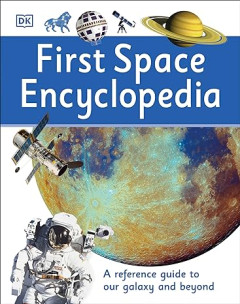
E-book First Space Encyclopedia
Reach for the stars in the updated First Space Encyclopedia! Explore the planets and discover amazing facts about nearby galaxies. A delightful first reference book about space for young astronomers, First Space Encyclopedia takes readers on a journey through the universe, from the beginning of space itself to current space technology. Find out what it takes to be an astronaut, what it is…
- Edisi
- -
- ISBN/ISSN
- 978024118743
- Deskripsi Fisik
- 138 halaman, ilus.
- Judul Seri
- -
- No. Panggil
- 523.112 NAN f
 Karya Umum
  Filsafat
  Agama
Agama  Ilmu-ilmu Sosial
  Bahasa
  Ilmu-ilmu Murni
  Ilmu-ilmu Terapan
  Kesenian, Hiburan, dan Olahraga
  Kesusastraan
  Geografi dan Sejarah